
Looking for an Asana alternative? This one is written for enterprise PMOs running a real evaluation. Eighteen requirements, the plan each capability actually ships in, both vendors’ published prices, and the places each product is the weaker choice.
Commercial disclosure: PPM Express produced and funded this comparison. Every assessment was drafted with AI from the vendors’ own published documentation, then reviewed and approved by PPM Express Analysts before publication. It evaluates publicly documented product capabilities against a defined requirement set; it is not independent analyst research or a benchmark test of both systems on the same dataset.Read the full method
Asana Enterprise is a mature collaborative work platform with genuinely good goals, a real two-way Jira Cloud sync built in-house, unlimited AI actions and capacity planning that spans quarters. The complication for a PMO is how much of the buying case sits outside the plan. Budgets, rates and billable time are a paid add-on. Audit logging is a paid add-on unless you go to Enterprise+. Azure DevOps needs third-party middleware. And Asana publishes no Enterprise price at all. Pick PPM Express if portfolio financials, capacity and governed reporting are requirements. Pick Asana if broad adoption and collaborative execution are what you are actually buying.
Primary trade-off: For team adoption, collaborative execution and everyday usability, Asana is the more polished product.
Primary trade-off: Much of the PMO case is priced separately: budgets, rates and billable time need the Timesheets and Budgets add-on, and audit logging needs Enterprise+ or the Compliance Management add-on. Azure DevOps has no Asana-built connector, and capacity plans do not reconcile with workload.
The default scenario is an enterprise hybrid PMO with 250 modeled users, 75 to 250 active initiatives, several delivery systems in play, and a need for centralized portfolio, resource, financial and executive reporting.
Wants everyone in the portfolio, governance across the tools teams already use, resource and financial control, and a cost that does not move when headcount does.
Leads at the default 250-user benchmark because the $25,000 annual plan includes unlimited users and broad participation is mandatory.
Goals, delivery and AI are strong. Portfolio financials behind an add-on, and Azure DevOps needing middleware, are what cost it here.
| Customer requirement | Priority | PPM Express | Asana |
|---|---|---|---|
Connect strategy, objectives, and execution Map initiatives to strategy and track progress against objectives or key results. Strategy | Mandatory | ✓ MeetsIncluded in Enterprise UltraStrategy and OKR modules are included in the evaluated Enterprise Ultra plan.Sources [2] | ✓ MeetsEnterpriseGoals can be classified as objectives, key results or individual goals, nested into sub-goals, and connected to the projects, portfolios and tasks that support them, with progress rolling up automatically.Sources [8], [9] |
Manage portfolio and project hierarchy with roll-ups Centralize initiatives and provide governed portfolio-level health, status, dates, risks, and decisions. Portfolio governance | Mandatory | ✓ MeetsIncluded in Enterprise UltraUnlimited portfolio, program, and project management are included in the evaluated Enterprise Ultra plan.Sources [2] | ◐ Partially meetsEnterprisePortfolios centralize projects, nest inside one another, show status, progress, dates and owner, and sum global custom fields such as estimated cost. There is no dedicated portfolio risk register or decision log.Sources [9] |
Capture ideas and prioritize proposed work Collect requests, score them consistently, and move approved initiatives into delivery. Intake & prioritization | Important | ✓ MeetsIncluded in Enterprise UltraInnovation and ideation plus standard prioritization frameworks are included in the evaluated Enterprise Ultra plan.Sources [2], [3] | ◐ Partially meetsEnterpriseForms with branch logic, structured request fields, routing rules and rule-created approval subtasks cover intake properly. No built-in scoring or evaluation model for proposed work is documented.Sources [9] |
Compare advanced portfolio what-if scenarios Model competing investment mixes using strategy, budget, capacity, timing, targets, and dependencies. Portfolio modeling | Important | ◐ Partially meetsIn Enterprise Ultra; depth worth checkingPrioritization, optimization, roadmaps and resource what-if reporting are all documented. If you model several competing investment mixes side by side, check that depth against your own decision process.Sources [3], [4] | ? Not verifiedEnterpriseNo official documentation describes constrained what-if modeling of investment options against budget and capacity. It does not appear in the plan comparison, the portfolio articles or the resource management pages.Sources [9] |
Plan resource capacity and utilization Balance demand and capacity across roles, named resources, teams, projects, and time periods. Resources | Mandatory | ✓ MeetsIncluded in Enterprise UltraThe evaluated plan supports hours, percent, and FTE planning, capacity, availability, and proposed and committed allocations.Sources [4] | ◐ Partially meetsEnterpriseCapacity Planning is an Enterprise feature that allocates people to projects over ranges from days to quarters and flags over-allocation, and Universal Workload spans the organization. Allocation is to named individuals rather than roles, and Asana states that capacity plans and workload are not connected.Sources [9], [10] |
Manage budgets, forecasts, actuals, benefits, and ROI Provide portfolio and project financial control and connect spend to expected value. Financials & benefits | Mandatory | ✓ MeetsIncluded in Enterprise UltraBuilt-in financials support budgets, forecasts, actuals, benefits, fiscal and non-fiscal values, and estimated ROI.Sources [5] | ◐ Partially meetsEnterpriseProject budgets, user rates feeding those budgets, budget currency, and estimate against actual cost reporting all exist, but only in the paid Timesheets and Budgets add-on. Benefits realization and ROI are not documented.Sources [9], [11] |
Support waterfall, agile, and hybrid delivery Allow teams to use native schedules or external delivery tools without losing portfolio governance. Delivery | Mandatory | ✓ MeetsIncluded in Enterprise UltraNative task scheduling supports traditional, sprint, and task-list approaches; external schedules can be linked.Sources [1], [2] | ✓ MeetsEnterpriseList, board, calendar and timeline views with dependencies and milestones cover both models, and every view is included on Enterprise. Critical path and schedule baselines are not documented.Sources [9] |
Track time and effort against work Capture actual effort for projects and tasks and use it in reporting and resource analysis. Time | Important | ✓ MeetsIncluded in Enterprise UltraUnlimited time tracking, advanced approvals, and custom fields are included in the evaluated Ultra plan.Sources [2] | ✓ MeetsEnterpriseNative time tracking is included from Advanced upward, with estimated and actual time, a built-in timer, subtask roll-up and estimate against actual charts. Full timesheet entry with a billable flag sits in the paid add-on.Sources [9], [11] |
Generate and distribute AI-assisted status reports Create standardized executive reports with AI narratives and scheduled PDF or email delivery. Executive reporting & AI | Mandatory | ✓ MeetsIncluded in Enterprise UltraProject Story supports AI summaries, configurable single- and multi-page reports, scheduled PDF email, and unlimited recipients in the evaluated plan.Sources [6] | ◐ Partially meetsEnterpriseSmart status drafts project, portfolio and goal updates with AI on Enterprise, and posted updates reach members through the inbox and project overview. Generation is user-initiated; no configurable report cadence or external distribution list is documented.Sources [9], [12] |
Use AI for portfolio and project decision support Ask portfolio questions, identify risk, generate plans, summarize health, and automate routine management work. AI | Important | ✓ MeetsIncluded in Enterprise UltraPPM Insights, status prediction, project digest, task and risk AI, schedule generation, and advanced AI agents are included in the evaluated plan.Sources [1], [2] | ✓ MeetsEnterpriseAsana AI covers smart status, summaries, goals, fields and rule creation, and Enterprise carries unlimited AI actions where Starter and Advanced are capped. AI Studio adds a no-code builder for smart workflows.Sources [9], [12] |
Consolidate delivery data from multiple work systems Roll up work from Jira, Azure DevOps, Planner, Project, Smartsheet, monday.com, and other systems into a portfolio view. Integrations | Mandatory | ✓ MeetsIncluded in Enterprise Ultra, with setup conditionsStandard integrations plus two-way Jira and Azure DevOps are covered by this plan. Confirm setup and the conditions on each connected system.Sources [1], [2], [7] | ◐ Partially meetsEnterpriseAsana-built connectors cover Jira Cloud, Salesforce and ServiceNow, and Power BI and Tableau connectors export portfolios, goals, allocations and tasks. Azure DevOps has no Asana-built connector and no Microsoft Planner data sync was found.Sources [10], [13] |
Synchronize Jira and Azure DevOps work in both directions Create or update connected tasks and work items while preserving team execution in the source system. Bidirectional integration | Mandatory | ✓ MeetsIncluded in Enterprise UltraTwo-way Azure DevOps and Jira synchronization is included in the evaluated Ultra plan and uses vendor-assisted setup.Sources [7] | ◐ Partially meetsEnterpriseJira Cloud sync is genuinely two-way and built by Asana, though bounded: URL, sprint and story points are one way, several field types are unsupported, subtasks are excluded and import caps at 150 issues. Azure DevOps is served only by Unito, a third party requiring its own subscription.Sources [13], [14] |
Provide API, Power BI, and workflow automation Enable enterprise reporting, data export, integration, and repeatable process automation. Data & automation | Important | ✓ MeetsIncluded in Enterprise UltraREST API, Power Automate and Zapier connectors, built-in dashboards, and Power BI report packs are included in the evaluated plan.Sources [1], [2] | ✓ MeetsEnterpriseA REST API with webhooks at 1,500 requests per minute on paid plans, an Asana-built Power BI connector, a Tableau connector, multi-step rules and reusable workflow bundles on Enterprise.Sources [10], [13] |
Configure the platform without custom software development Allow PMO administrators to adapt fields, views, templates, rules, and workflows as practices mature. Administration | Important | ✓ MeetsIncluded in Enterprise Ultra, configured by the PMOTemplates, custom fields, views, filters, layouts and modules are all administrator-managed.Sources [1] | ✓ MeetsEnterpriseCustom fields, forms with branch logic, multi-step rules, reusable rule bundles, templates and AI Studio workflows defined in natural language are all configured without code.Sources [9], [12] |
Support enterprise permissions, audit, and controlled environments Provide access controls, auditability, protected work, sandboxes, and environment options where required. Security & governance | Important | ✓ MeetsIncluded in Enterprise UltraThe evaluated plan includes private projects, audit, advanced permissions, multiple tenants or sandboxes, dedicated hosting, and premium support options.Sources [2] | ◐ Partially meetsEnterpriseEnterprise brings SAML SSO, SCIM, service accounts, admin controls and a choice of data regions. The audit log API, data loss prevention, eDiscovery and archiving require Enterprise+ or the paid Compliance Management add-on, so audit logging is an extra purchase on plain Enterprise.Sources [9], [15] |
Allow broad participation without per-seat price growth Give employees, executives, team members, and viewers access without annual cost increasing for every additional user. Commercial model | Mandatory | ✓ MeetsFlat annual plan, Enterprise UltraEnterprise Ultra is $25,000 per year with unlimited users. Enterprise is listed in the pricing reference table but is not used in the comparison calculations.Sources [1], [2] | ◐ Partially meetsEnterpriseGuests are free and unlimited on every tier and do not count toward the membership count. Guest status is decided by email domain, so anyone on the company domain is a member and consumes a paid seat, which means internal occasional participants cannot be free.Sources [9], [16] |
Run professional services delivery and profitability Manage client delivery, billable utilization, time, costs, charges, and profitability as an integrated operating model. Professional services | Optional | ◐ Partially meetsComponents included in Enterprise UltraTime, resource planning, task costs, charges and profitability are all there. A complete native PSA operating model is not documented as one.Sources [1], [5] | ◐ Partially meetsEnterpriseTimesheets, billable flags, user rates per project and estimate against actual cost reporting exist in the paid Timesheets and Budgets add-on at $5.99 per user per month. A separate internal cost rate paired against a bill rate, and margin reporting, are not documented in the help centre.Sources [11] |
Map enterprise architecture and business capabilities Visualize initiatives, dependencies, capabilities, outcomes, and architecture relationships across the enterprise. Enterprise architecture | Optional | ◐ Partially meetsRoadmaps and strategy visualization in Enterprise UltraRoadmaps and strategy visualization are available. A dedicated enterprise architecture model is not.Sources [1], [2] | ? Not verifiedEnterpriseNo official documentation covers enterprise architecture modeling, application portfolio management or business capability mapping. The closest published material is generic process-map templates.Sources [9] |
How the score works: Meets = 1, Partially meets = 0.5, Does not meet = 0. Mandatory requirements weigh more than Important ones, and Important more than Optional. Read the table. The percentage is a summary of it, not the result.
The $24.99 per user per month figure quoted in most Asana comparisons is the Advanced tier. Capacity planning, universal workload, SAML SSO, SCIM, service accounts and workflow bundles all require Enterprise, and Asana publishes no Enterprise price. If you are modeling $74,970 for 250 users, you are modeling a plan without those.
Budgets, user rates and billable time live in Timesheets and Budgets at a published $5.99 per user per month, roughly $17,970 a year at 250 users. Audit logging, data loss prevention and eDiscovery need Enterprise+ or the Compliance Management add-on, whose price is not published. Add them up before comparing totals.
Asana's unlimited free guests are genuinely useful, and they do not count toward the membership count. The catch is that guest status is decided by email domain, so your own finance, legal and executive stakeholders are members and consume paid seats. PPM Express prices for unlimited internal participation instead.
A comparison that only lists strengths is a brochure. Check each of these against your own operating model, the integrations you actually need, and how much implementation capacity you have.
Packaged enterprise PPM. One price, no seat count.
Collaborative work management, sold in tiers plus add-ons.
The short version: PPM Express if portfolio financials, capacity planning and governed reporting are requirements you expect in the plan. Asana if broad collaborative adoption is the goal and you are prepared to price Enterprise plus the add-ons that carry the PMO functions.
Every figure here is an annual cost. Enterprise Ultra is the plan being compared on the PPM Express side; PPM Express Enterprise appears as a price reference only. Asana does not publish a price for Enterprise, which is the plan assessed above, so the rows below show Asana Advanced, the published tier immediately beneath it, at $24.99 per user per month. Treat that as a floor rather than a quote: Enterprise costs more than Advanced, and Asana does not say how much more.
Pricing was verified from each vendor’s public website on August 23, 2026.
Default summary scenario: 250 users. Official pricing sources: PPM Express [17] and Asana [8].
Calculation assumption: Asana Advanced at the published $24.99 per user per month, so Asana annual cost = users × $24.99 × 12. The comparison above assesses Asana Enterprise, which is quoted rather than published and costs more than Advanced, so the real gap is wider than the rows show. Advanced also excludes capacity planning, universal workload, SAML SSO, SCIM, service accounts, workflow bundles and view-only licences, all of which require Enterprise. Timesheets and Budgets is a further add-on at a published $5.99 per user per month, which is another $17,970 a year at 250 users, and it is where budgets, rates and billable time actually live. Asana bills in seat buckets of 25 between 100 and 500 users rather than exact headcount. PPM Express Enterprise Ultra remains $25,000 per year with unlimited users. Three-year figures assume unchanged list prices and no discounting. Taxes, discounts, implementation, migration, support and professional services are excluded on both sides.
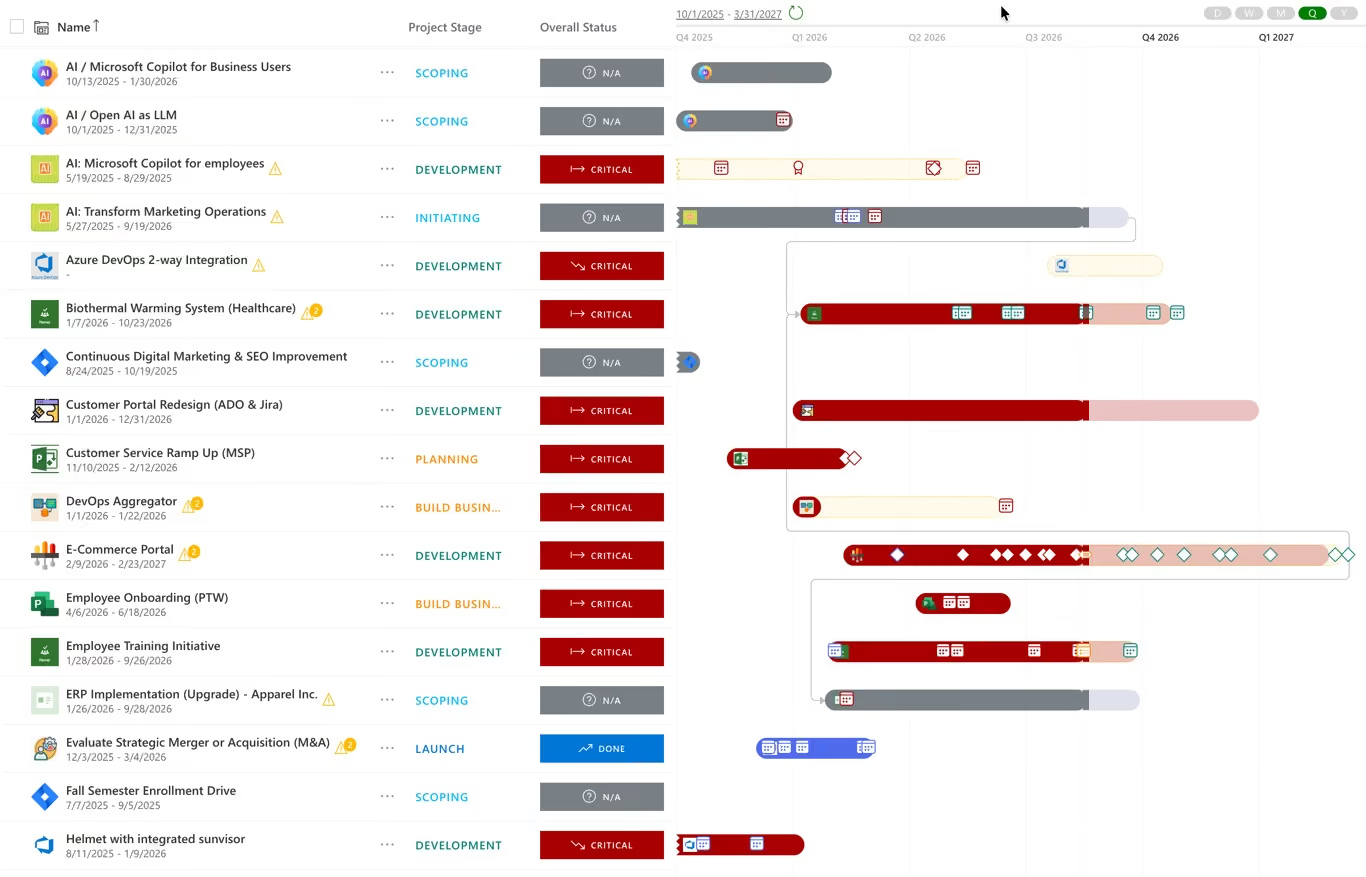
Illustrative product image from the PPM Express website. Product interfaces change over time.
Explore PPM ExpressThis is not a bake-off. Nobody loaded the same dataset into both products. What it does check is whether each vendor publicly documents a capability that meets the requirement, and what edition, integration or service you need to get it.
The full method is published. The eighteen requirements, the weightings, the three buyer scenarios, the evidence rules and the limitations are all set out on the comparison methodology page.
Requirement coverage, plans, integrations and published pricing.
For a portfolio office, yes, though the two solve different halves of the problem. Asana is strongest where teams collaborate and execute. PPM Express is strongest where work gets funded, resourced and reported on. If Asana is already well adopted, the more common outcome is PPM Express above it rather than instead of it.
Asana does not publish an Enterprise price, and Enterprise is the plan assessed here. Advanced, the tier below it, lists at $24.99 per user per month, which is $74,970 a year at 250 users, so treat that as a floor. PPM Express Enterprise Ultra is $25,000 a year with unlimited users.
Capacity Planning, Universal Workload, SAML SSO, SCIM provisioning, service accounts, reusable workflow bundles and view-only licences. Unlimited AI actions are also Enterprise; Starter is capped at 150 a month and Advanced at 1,500.
Only through the Timesheets and Budgets add-on, which is a separate purchase at a published $5.99 per user per month, roughly $17,970 a year at 250 users. That add-on carries project budgets, user rates and the billable flag. A separate internal cost rate paired against a bill rate, and margin reporting, are not documented in Asana's help centre.
PPM Express includes two-way Jira and Azure DevOps synchronization in the evaluated plan. Asana's Jira Cloud sync is genuinely two-way and built in-house, though field coverage is bounded and it does not cover Jira Server or Data Center. Azure DevOps has no Asana-built connector; the only listed integration is Unito, a third party requiring its own subscription.
Where funding, scoring, gates and benefits live. Strategic portfolio management
The constraint most portfolios actually fail on. Resource capacity planning and utilization
Test a funding mix before you commit to it. Portfolio what-if scenario planning
All material feature and pricing statements are based on public vendor sources accessed on or before August 21, 2026. Product packaging and functionality may change.
.svg)


